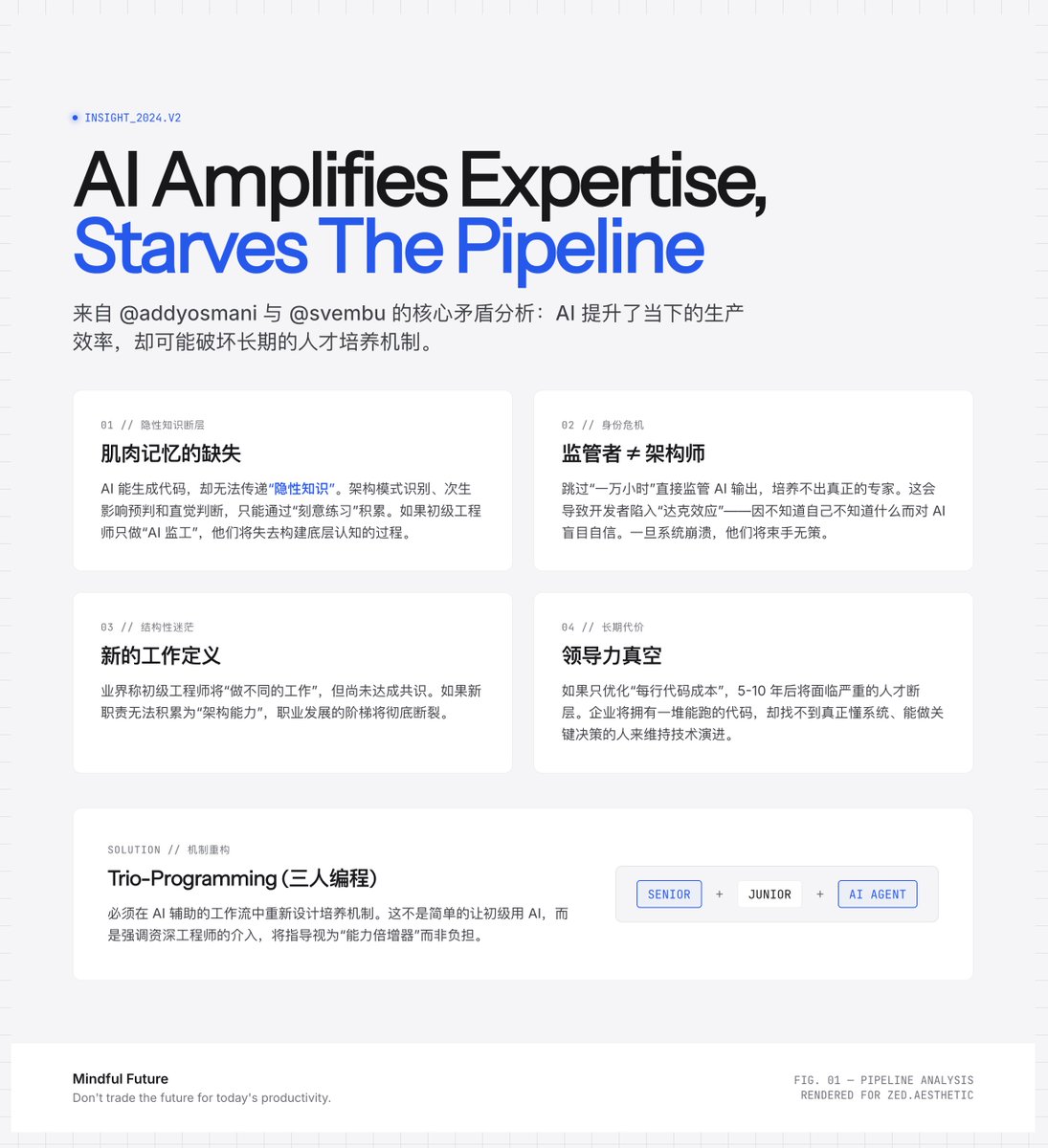
AI amplifies senior expertise but may starve the junior pipeline that creates it. That is, if we only optimize for today's productivity vs. the long-term.

The muscle memory of fields like software engineering develops through repetition and guided practice.

Knowing when to trust your instincts. Recognizing antipatterns. Understanding second-order consequences of technical decisions.

AI agents can generate code, but can't transfer the tacit knowledge that separates someone who can review AI output from someone who can architect systems.

What worries me is if we skip the "10,000 hours of practice" phase and jump straight to "overseer of AI output," are we actually training architects? Or are we training people who don't know what they don't know?

The industry keeps saying "juniors will do different work now." but there isn't yet alignment about what that work actually is, how it builds toward senior capabilities, or whether it creates the judgment AI assistance assumes you already have.

Maybe the resolution isn't either/or. Maybe it's hybrid pair-programming where juniors work alongside AI but with better senior oversight and deliberate skill-building, not just task completion.

You could call it trio-programming. Seniors who see mentorship as force multiplication but not a tax on their productivity.

If companies optimize purely for cost-per-line-of-code today, we'll pay for it in a leadership vacuum in the coming years. I hope we're more mindful of the future than that.